
A cremation service Bronx, NY involves several careful steps before cremated remains are returned to a family. Cremation does not begin immediately after a death, and the final return involves identification, authorizations, preparation, tracking, and respectful placement in the container the family has selected.
Key Takeaways
Identification and authorizations are completed before cremation begins.
Personal belongings need clear instructions before preparation starts.
Tracking records remain with the person throughout the provider’s care.
Return timing can depend on documentation, scheduling, preparation, and final handling.
Families can ask specific questions about communication and return arrangements.
The Process Starts with Careful Identification
Cremation begins with careful identification, not with the cremation chamber. A provider must first confirm who is in its care and complete the required paperwork and authorizations before moving forward. This protects the family’s wishes and creates a clear record at each stage.
The first hours after a death can feel rushed because families have many decisions to make. Still, some steps should not be hurried. The funeral home gathers needed information, confirms the identity of the deceased, and reviews the arrangements chosen by the person with authority to make decisions.
Cremation providers also need time to coordinate the transfer, preparation, and scheduling of the cremation itself. A delay is not automatically a sign that something has gone wrong. Often, it reflects the care taken to follow the family’s directions and complete each part of the process in the proper order.
Is Identity Confirmed More Than Once?
Yes. Identification is generally checked at more than one point, rather than only when the person first enters the provider’s care. Labels, paperwork, and internal records work together so the identity associated with the deceased stays connected throughout preparation, cremation, and final return.
Families should feel comfortable asking how identification is maintained. A clear answer should explain the provider’s general process in plain language, without making the family feel as though they are asking an unreasonable question.
Authorizations Come Before Cremation
Authorization must be in place before cremation can proceed. The funeral home reviews the family’s instructions and obtains the documentation needed to confirm that cremation is the selected form of final care.
If several relatives are involved, it can help to choose one main point of contact early. That person can receive updates, relay decisions, and reduce confusion when questions arise.
Why Aren't Remains Returned Right Away?
Cremated remains are not usually ready for immediate return because several steps occur before and after cremation. Timing may vary based on paperwork, scheduling, preparation, processing, and the arrangements made for release to the family.
The following stages help explain why a short wait can be part of a careful process.
| Stage | What Happens | Why It May Take Time |
|---|---|---|
| Identification | Records and labels are reviewed | Details must match |
| Authorization | Family directions are confirmed | Documents need completion |
| Preparation | Personal items and devices are addressed | Instructions may be needed |
| Cremation | The service is scheduled and completed | Facility timing varies |
| Final handling | Remains are processed and placed | Return arrangements are coordinated |
After the cremation itself, the work is not finished. Cremated remains need to be handled, processed, placed in the selected container, labeled, and prepared for pickup or another agreed return arrangement.
What Happens During Preparation?
Preparation is the respectful period before cremation when the provider follows the family’s directions and checks for items that should not enter the cremation chamber. The care team may also prepare the deceased according to any viewing, private farewell, religious, or personal arrangements that were selected.
This stage is important because certain belongings and devices require special attention. Families may not know what their loved one had with them when they arrived in the funeral home’s care, especially after a hospital stay or emergency transfer. Asking early about personal property can prevent uncertainty later.
A family may also have meaningful instructions, such as whether a ring should remain with the deceased or be returned to a relative. Those decisions are personal. The best time to state them is before preparation is complete, in writing where possible.
Personal Items Need Clear Instructions
Personal items should be discussed clearly before cremation. Jewelry, glasses, clothing, religious items, keepsakes, and other belongings may be returned, retained, or handled according to the family’s instructions and the provider’s practices.
Do not assume a particular item will stay with the deceased or automatically come back to the family. Tell the funeral home what matters, identify who should receive returned belongings, and ask how that instruction will be recorded.
Medical Devices May Require Removal
Some medical devices may require removal before cremation because they are not suitable for the cremation chamber. The provider can explain what needs to be addressed and whether any information from a hospital, care facility, or family member is helpful.
Mentioning implanted devices or recent medical treatment can help the funeral home prepare properly. This is a practical detail, not an added burden on the family.
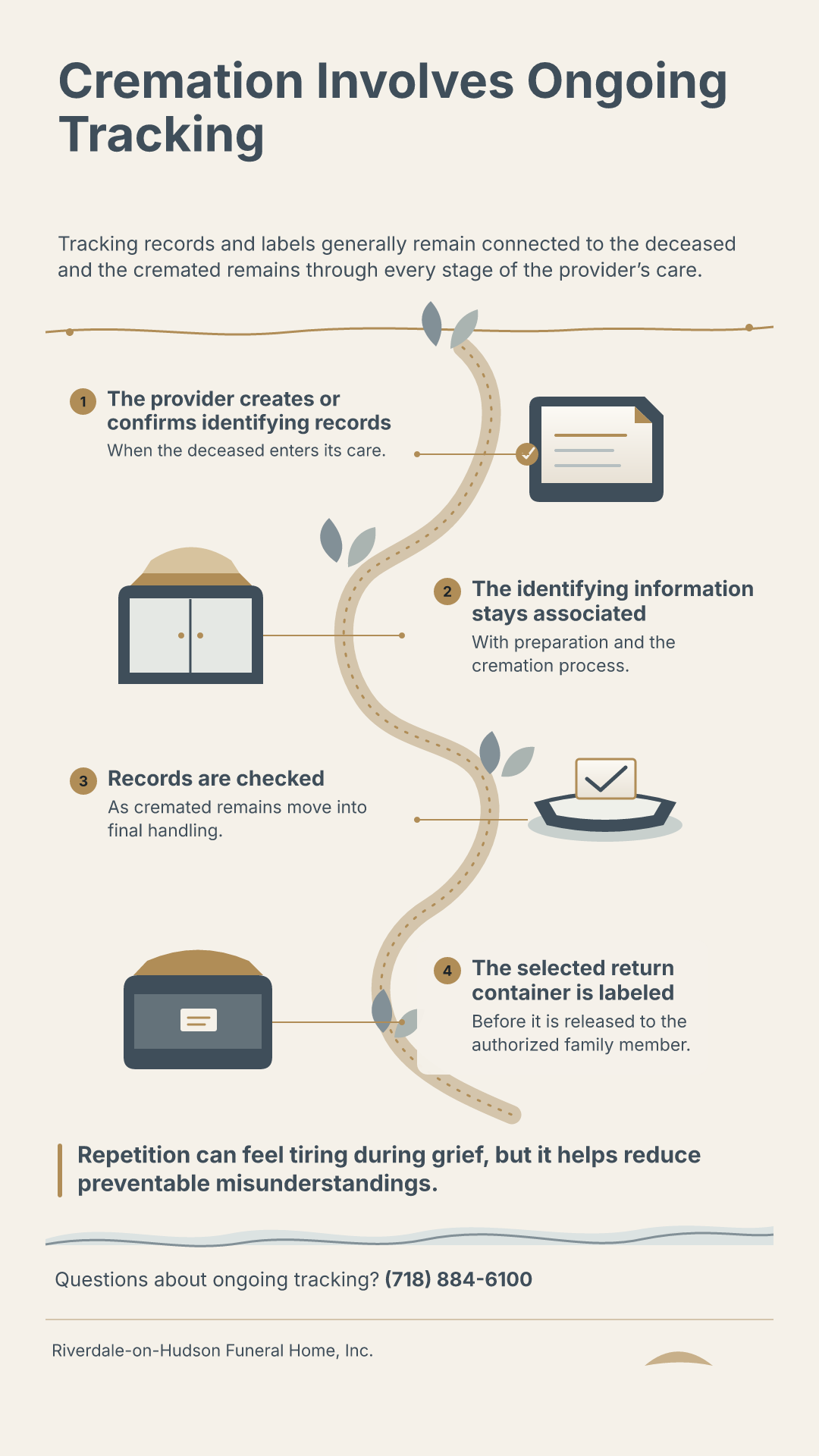
Cremation Involves Ongoing Tracking
Identification does not end once authorization is signed. Tracking records and labels generally remain connected to the deceased and the cremated remains through every stage of the provider’s care.
The provider creates or confirms identifying records when the deceased enters its care.
The identifying information stays associated with preparation and the cremation process.
Records are checked as cremated remains move into final handling.
The selected return container is labeled before it is released to the authorized family member.
This chain of identification is one reason providers may need families to confirm names, contact details, and release instructions more than once. Repetition can feel tiring during grief, but it helps reduce preventable misunderstandings.
For a broader look at decisions that follow the return, review guidance for the next steps.
The Final Care of Cremated Remains
After cremation, cremated remains are allowed to cool before they are processed and prepared for return. Processing generally means placing the remains into a uniform form suitable for the selected container. This is a standard final-care step, handled before the family receives them.
The provider then places the cremated remains in the container selected during arrangements, or in another appropriate container if that is what the family chose. The container is labeled so it remains connected with the person’s identity and the family’s arrangements.
This final phase may also include coordinating who is authorized to receive the remains. If more than one relative is involved, decide in advance who will pick them up and whether identification or other confirmation will be needed at release.
Are Cremated Remains Processed Before Return?
Yes. Cremated remains are generally processed before return, then placed in the family’s selected container and labeled. The exact handling can vary by provider and by the arrangements chosen, so it is appropriate to ask what the family should expect.
The return of cremated remains is a meaningful moment for many people. Knowing the steps beforehand can make that moment feel less uncertain and can help relatives focus on the remembrance that follows.
Families Can Ask About Return Arrangements
Families can ask whether pickup is expected, whether delivery may be available, who may receive the remains, and how they will be notified when everything is ready. It is also reasonable to ask where personal belongings will be kept until they are returned.
Those who are planning a tribute may find ideas in this article about would often engage others in song memory tribute. The memorial plans and the cremation timeline can be coordinated, but they do not have to follow one fixed order.
Questions Families Can Ask the Provider
Clear questions can make a difficult process easier to follow. When discussing cremation services for families, consider asking:
Who will be the main contact for updates?
How will personal belongings be recorded and returned?
What items need special instructions before cremation?
How is identification maintained during care?
What affects the expected return timeline?
What container will be used for the cremated remains?
Who is authorized to receive them, and how will release be arranged?
A provider should welcome these questions and explain the answers without rushing you. Writing down answers can also help relatives who were not present during the arrangement conference.
Careful identification, preparation, tracking, and final placement are the reasons a cremation service Bronx, NY may involve a wait before cremated remains are returned. Riverdale-on-Hudson Funeral Home, Inc. is available to talk with our team about the process and your family’s questions. Call (718) 884-6100 to talk it through.