
Key Takeaways
Call before ordering so the gift fits the family’s plans and the home’s delivery process.
Include the deceased person’s full name and the sender’s name with every delivery.
Choose a gift that is appropriate for the service setting and easy for the family to receive.
A warm card and practical support can matter more than the size of a gift.
Respect religious, cultural, and personal preferences when deciding what to send.
When You Want to Send Support
A sympathy gift can be a meaningful way to show care, but the most helpful choice begins with the family’s situation, not the item itself. A funeral home in Bronx, NY may be coordinating a visitation, a ceremony elsewhere, a private gathering, or a later memorial, and each arrangement can affect whether a delivery is welcome and when it should arrive.
A brief call before ordering is a considerate first step. The funeral home can often confirm whether deliveries are being accepted, where an item should be brought, and what identifying details are needed. That small check can prevent a gift from arriving after services have ended or without enough information to connect it to the right family.
Support does not need to be elaborate to be sincere. The goal is to acknowledge the loss without creating another decision for relatives who are already managing many details. If you are unsure whether a delivered item is appropriate, ask about the service plan before making a choice.
Which Sympathy Gift Fits the Setting?
The right sympathy gift depends on the service, the family’s preferences, and whether the item needs care or space at the funeral home. These common options serve different purposes.
| Gift Category | Practicality | Delivery Needs | May Be Appropriate When |
|---|---|---|---|
| Floral arrangement | Visible tribute | Name and service timing | A visitation or ceremony is planned |
| Living plant | Longer-lasting remembrance | Confirm placement space | The family welcomes a keepsake |
| Food or meal support | Useful after services | Coordinate directly with family | Household needs are known |
| Donation in memory | No physical delivery | Confirm organization preference | The family names a cause |
| Handwritten card | Simple and personal | Clear sender identification | You want to express care quietly |
Flowers may be displayed during a service, but a very large arrangement may not fit every setting. A plant can be thoughtful if someone is able and willing to care for it afterward. Food is often best sent to a home rather than a funeral location, since it can be difficult to store or distribute during services.
A donation or a personal card may be the better choice when the family has asked for simplicity. If relatives are sharing responsibilities, a guide to dividing funeral tasks can also help explain why clear communication matters at this time.
Before Placing the Order
A delivery provider needs more than a funeral home name. Before ordering, confirm the deceased person’s full name, the date and time of any visitation or service, and whether the item should be delivered to the funeral home, a place of worship, or the family’s residence.
It is also wise to ask whether there are limits on what can be received. Some items need water, refrigeration, a table, or extra handling. Staff may be able to accept certain deliveries, but that does not mean every item is suitable for the schedule or available space.
Can the Home Accept This Delivery?
Yes, a funeral home may accept a sympathy delivery, but you should confirm the details before sending it. Funeral arrangements vary, and a private service, a gathering at another location, or a short visitation can change what the home can receive.
Ask the delivery provider to call ahead if timing is uncertain. Do not assume that a gift addressed only to “the family” will be easy to place correctly, especially if more than one service is being coordinated.
Details That Help Staff Identify It
The delivery label should include the deceased person’s full name, along with the name of the person or group sending the gift. Include a phone number for the sender or delivery provider in case a question comes up.
A card should also clearly state who it is from. A signature such as “Your coworkers” may be meaningful if the family knows the group, but adding a department, workplace, or individual names can make the connection clearer.
Timing Around Services and Visitation
Ask for the planned delivery window rather than choosing a time based only on the event date. An item delivered too early may need to be held, while one delivered late may miss the visitation or require the family to arrange pickup afterward.
Service times can change as arrangements develop. Families weighing different formats may find it useful to read about choosing a fitting service format, since the location and timing of a tribute often shape delivery decisions.
A Gift Should Respect Family Wishes
A thoughtful gesture recognizes that every family has different traditions, beliefs, and needs. Before sending an item, weigh the following considerations:
Check whether an obituary or family notice requests donations instead of flowers.
Consider religious or cultural customs that may shape what is suitable.
Avoid gifts that require immediate care, storage, or transportation unless confirmed.
Choose a modest, respectful card message without asking the family to respond.
Send food, household help, or a personal note later if the funeral home delivery is not practical.
Offer a specific form of help, such as bringing a meal or making a phone call another day.
A non-delivery gesture can be especially meaningful after the service, when many people have returned to their routines and the family is facing quieter days. A note sent later, a meal arranged with permission, or a donation in memory may be more useful than an item delivered during a busy schedule.
What Should the Card Say?

A sympathy card should be brief, sincere, and easy for the family to receive. State that you are sorry for their loss, name the person who died if appropriate, and identify yourself clearly.
You do not need to explain grief or offer advice. Simple wording such as, “I am so sorry for your loss. I will remember the kindness your mother showed me,” can feel personal without placing pressure on anyone to reply. If you did not know the deceased well, it is still appropriate to say that you are thinking of the family.
Avoid phrases that assume how someone feels or promise ongoing help you may not be able to provide. If you do offer support, make it specific and realistic, such as, “I can bring dinner next week if that would be useful.”
Coordinating Delivery in Bronx
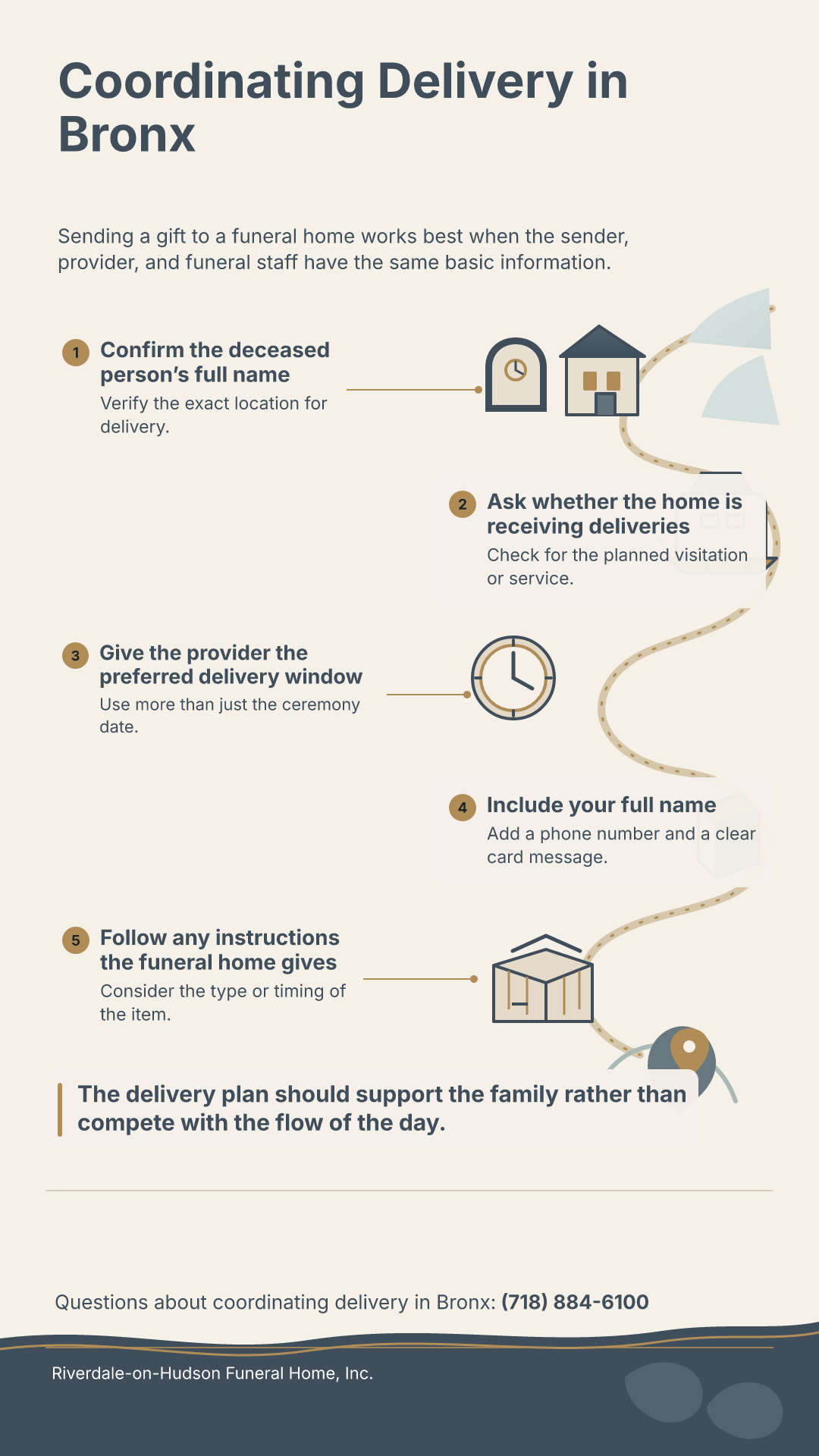
Sending a gift to a funeral home works best when the sender, provider, and funeral staff have the same basic information. Follow these steps before confirming an order:
Confirm the deceased person’s full name and the exact location for delivery.
Ask whether the home is receiving deliveries for the planned visitation or service.
Give the provider the preferred delivery window, not just the ceremony date.
Include your full name, a phone number, and a clear card message.
Follow any instructions the funeral home gives about the type or timing of the item.
For funeral and memorial services, the delivery plan should support the family rather than compete with the flow of the day. Details about Bronx funeral services can also help you understand why timing and location may differ from one family’s arrangements to another.
This week, take a moment to confirm the family’s wishes and call before placing an order, especially when sending an item to a funeral home in Bronx, NY. Riverdale-on-Hudson Funeral Home, Inc. can clarify delivery details and service timing, and you can talk with our team at (718) 884-6100.