
Key Takeaways
A single family contact helps prevent conflicting instructions and missed details.
Many early arrangement conversations can be handled by phone or online.
The provider should explain which documents and signatures are needed for the circumstances.
Clear questions about transfer, updates, belongings, and final disposition help families compare options.
Remote planning still allows relatives to make careful, respectful decisions.
A Clear Path From Any Distance
Choose a provider that can explain remote arrangements plainly, help your family name one contact person, and separate what must be handled locally from what can be managed from afar. A cremation service Bronx, NY should not feel harder simply because relatives live in another city or state.
Distance changes how information is shared, not the importance of each decision. Families may need to communicate by phone, email, or secure online methods while the provider coordinates care where the death occurred. Procedures can vary based on the circumstances, the place of death, and the information available, so it is wise to ask what applies before making assumptions.
The first conversation should give you a workable outline. Ask who will guide the arrangements, what information is needed first, how updates will be given, and whether another family member can be copied on communications. Riverdale-on-Hudson Funeral Home, Inc. can also discuss cremation bronx arrangements in a way that keeps the next step clear.
Which Arrangement Method Fits Your Family?
The best arrangement method is the one that keeps decisions clear while fitting the family’s location, schedule, and ability to review information together. A mix of phone and written communication often gives distant relatives both personal guidance and a record of key details.
| Arrangement Route | Communication | Document Handling | Best Fit |
|---|---|---|---|
| Phone-led planning | Real-time conversation | Instructions sent afterward | One main decision-maker |
| Email-based planning | Written record for relatives | Forms shared for review | Family members in several places |
| Video conversation | Face-to-face discussion | Follow-up sent electronically | Relatives needing a group discussion |
| Local representative | One person handles local tasks | Provider explains needed steps | A trusted nearby relative |
| Combined approach | Calls plus written updates | Reviewed in stages | Families needing flexibility |
A phone conversation can be useful when a family needs immediate answers or has difficulty sorting through unfamiliar terms. Written follow-up matters because grieving relatives may not remember every detail discussed during an emotional call.
A video meeting may help siblings or adult children who want to hear the same explanation at the same time. It can reduce the chance that one person relays information differently than it was explained. Still, someone should be chosen to communicate the family’s final decisions.
A local relative can be helpful, but that person should not be left to guess what everyone else wants. Families planning remotely may also find guidance in this article about choosing a service format if they later decide they want a gathering or tribute.
What Information Keeps Arrangements Moving?
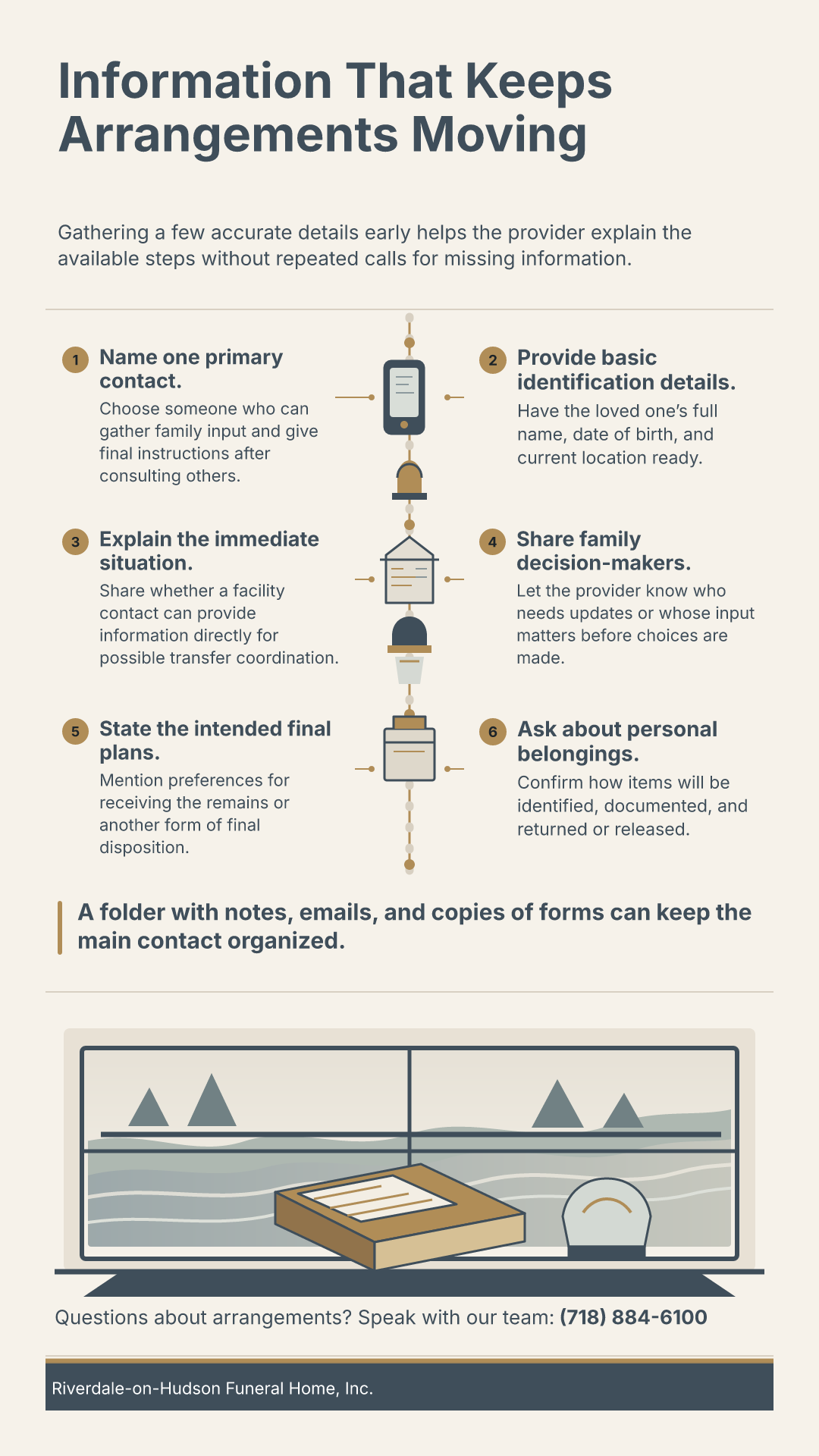
Gathering a few accurate details early helps the provider explain the available steps without repeated calls for missing information. The provider should then explain any required forms and local requirements based on the family’s circumstances.
Name one primary contact. Choose someone who can answer calls, gather family input, and give the provider final instructions after consulting others. Share that person’s phone number and email address first.
Provide basic identification details. Have the loved one’s full name, date of birth, current location, and other available identifying information ready. If details are uncertain, say so rather than guessing.
Explain the immediate situation. Tell the provider where the person is currently located and whether there is a facility contact who can share information directly. This helps the provider explain possible transfer coordination.
Share family decision-makers. Let the provider know whether there are relatives who need updates or whose input is important before choices are made. Clear communication early can prevent delays later.
State the intended final plans. If the family has preferences for receiving the remains or another form of final disposition, mention them. The provider can explain available options and any practical considerations.
Ask about personal belongings. Confirm how items will be identified, documented, and returned or released. Do not assume a facility and a funeral home have the same instructions for every item.
A folder with notes, emails, and copies of forms can keep the main contact organized. It also makes it easier to update relatives without repeatedly asking the provider to restate the same information.
Can Documents Be Completed Remotely?
Documents can often be reviewed and completed from a distance, but accepted methods depend on the circumstances and the provider’s instructions. Ask directly which forms apply, what identity-related information may be needed, and how signatures should be completed before returning anything.
Remote paperwork should never feel like a formality to rush through. Cremation authorization is an important family decision, and the person signing should understand what the form says, whether others need to be consulted, and what information must be accurate. If several relatives are involved, agree on the plan before forms begin moving between inboxes.
Ask Which Forms Apply
Ask the provider to identify each form needed for the arrangements and explain its purpose in plain language. A family may need to provide authorization, personal information, and details that support the provider’s coordination with the place where the person is located.
Do not rely on a form from another provider or a document used for a different situation. Requirements and procedures may differ, so the provider handling the arrangements should guide your family through the current paperwork.
Confirm Signature Instructions
Ask whether forms can be completed electronically, whether signatures must be witnessed, and how identification information should be submitted. Follow the instructions exactly, since incomplete fields, mismatched names, or missing pages can slow the process.
If more than one relative needs to participate, clarify the order of completion. Sending separate versions of the same form back and forth can create confusion, especially if family members make different changes.
Plan for Questions or Corrections
Set aside time to review forms before submitting them. A calm second reading can catch a misspelled name, an outdated address, or an instruction that does not match the family’s decision.
If something changes, notify the provider promptly rather than editing a document without explanation. Clear written communication creates a useful record and helps the provider confirm the next appropriate step.
Reliable Communication Reduces Uncertainty
A simple communication plan can spare a grieving family from avoidable confusion. Choose one main contact, one backup contact, and one method for sharing updates with the wider family, such as a group email or private message thread.
The main contact does not have to make every choice alone. Their role is to collect input, confirm the family’s shared decision, and communicate it consistently to the provider. This approach protects the provider from receiving conflicting instructions from several well-meaning relatives.
For example, if three siblings live in different states, they can agree to discuss questions together each evening and have one sibling send the final answer the next morning. That gives everyone a voice without creating a stream of overlapping calls.
Ask how often updates are likely to be available and who should receive them. Reliable updates are especially helpful when relatives cannot be present in person and need to plan travel, time away from work, or a later remembrance.
Questions That Support a Confident Choice

A provider should be able to explain its process clearly, even when you cannot visit in person. These questions can help your family compare choices without focusing only on convenience.
How can our family begin arrangements from another location?
Who will guide us through documents and explain what is needed?
How is transfer from the current location coordinated?
How will you provide updates, and who should receive them?
What instructions should we give about personal belongings?
What options are available for receiving the remains or choosing final disposition?
If questions arise after forms are submitted, who should our main contact call?
Listen for clear answers, not rushed promises. A respectful provider should explain what is known, what still needs confirmation, and what your family can do next. Information about cremation services may also help you frame questions before your first call.
Choosing with Care From Afar
Bring the loved one’s basic information, the main contact’s details, questions about documents, and the family’s preliminary wishes to the first conversation. A cremation service Bronx, NY can be arranged more calmly when relatives understand who is deciding, what information is still needed, and how updates will be shared.
To talk through your family’s next steps, talk with Riverdale-on-Hudson Funeral Home, Inc. at (718) 884-6100.