
The best approach is simple: follow the family’s plan, listen to the procession lead, and do not assume every guest must travel the same way. A funeral home in Bronx, NY can explain the travel plan before a service ends, which helps everyone move with less confusion at a difficult time.
Key Takeaways
A funeral procession may include only family, pallbearers, or selected guests.
Procession drivers should remain calm, alert, and respectful of normal traffic controls.
Pallbearers should follow assigned directions for travel, arrival, and carrying duties.
Guests should wait for cues before approaching the family at each location.
Asking for clarification is more respectful than guessing where to go.
Procession Expectations Vary by Service
A funeral procession is coordinated travel from one part of the service to another, often from a chapel or place of worship to a cemetery, graveside gathering, or reception location. Yet the route, vehicle order, participation, and travel instructions can differ widely depending on the family’s wishes and the service format.
Some families prefer a formal motorcade led by designated vehicles. Others ask only immediate family and pallbearers to travel together, while guests make their own way to the next location. A memorial service held after cremation may not include a procession at all.
The useful rule is to follow directions given that day, rather than relying on something you have attended before. The funeral director, a family contact, or a procession lead may explain where to park, which vehicles leave first, and whether guests should gather at the next location. Those details matter because a well-intended decision, such as following the wrong car, can create unnecessary stress for the family.
Should Every Guest Join the Procession?
No, not every guest needs to join a funeral procession. Guests may be invited to travel in the motorcade, drive independently, meet at the next location, or remain only for one part of the service.
Before leaving, it helps to confirm which choice applies to you.
| Guest Situation | Suitable Travel Choice | Why It May Help |
|---|---|---|
| Invited to follow | Join the motorcade | Keeps the group together |
| Comfortable navigating | Drive independently | Allows personal travel pace |
| Going to a later gathering | Travel directly there | Avoids an unnecessary stop |
| Unsure of the route | Ask before leaving | Prevents separation |
| Limited mobility needs | Use the easiest option | Supports a safer arrival |
A guest who drives separately is not showing less respect. Often, independent travel is the most practical choice, especially when parking is limited, someone needs extra time to walk, or a guest must leave after the next service.
If the family has shared an itinerary, keep it available in your phone or car. For broader preparation before the day of service, guidance on funeral arrangements can help families understand how travel and service details are coordinated.
What Should Drivers Know During a Procession?
Drivers should treat a funeral procession as a coordinated group of vehicles, not as permission to take risks. Courtesy matters, but safe, attentive driving and compliance with traffic controls matter just as much.
Turn on headlights if the procession leader asks, leave enough room between vehicles to react safely, and avoid abrupt lane changes. Keep your attention on the road rather than trying to maintain an exact distance from the vehicle ahead. If another vehicle enters the line, remain calm. Trying to close a gap aggressively can create a more serious problem than a brief separation.
Can Procession Vehicles Ignore Traffic Rules?
No. A funeral procession should not be treated as a reason to ignore traffic signals, signs, or directions from those managing traffic. Requirements can differ by location, so drivers should follow instructions provided for the route and check local requirements when necessary.
A vehicle that becomes separated should not rush to catch up by making unsafe turns or following too closely. Continue safely, use navigation if appropriate, and proceed to the agreed location. If you are uncertain, pull over only where safe and contact the person identified for questions.
Other Drivers and Safe Passing
Other motorists should respond with patience and caution when they encounter a funeral procession. If there is room to pass safely and doing so does not disrupt the line, proceed slowly and avoid cutting between vehicles.
Avoid honking, crowding a procession vehicle, or trying to force your way into the line. Not every road situation allows traffic to move around a procession right away, but a few extra moments of patience can protect everyone involved. Procession drivers should also avoid assuming that other motorists know the route or recognize the group.
Route Changes and Separation
Route changes can happen because of traffic, a missed turn, or directions given by procession staff. If you lose sight of the group, do not turn suddenly or reverse course in a travel lane.
Before departing, save the name and address of the next location if it is available. A simple plan makes a real difference. For example, a guest traveling independently to a cemetery may arrive ahead of the motorcade and wait quietly in the designated area rather than searching through arriving vehicles for family members.
Pallbearer Responsibilities During Travel
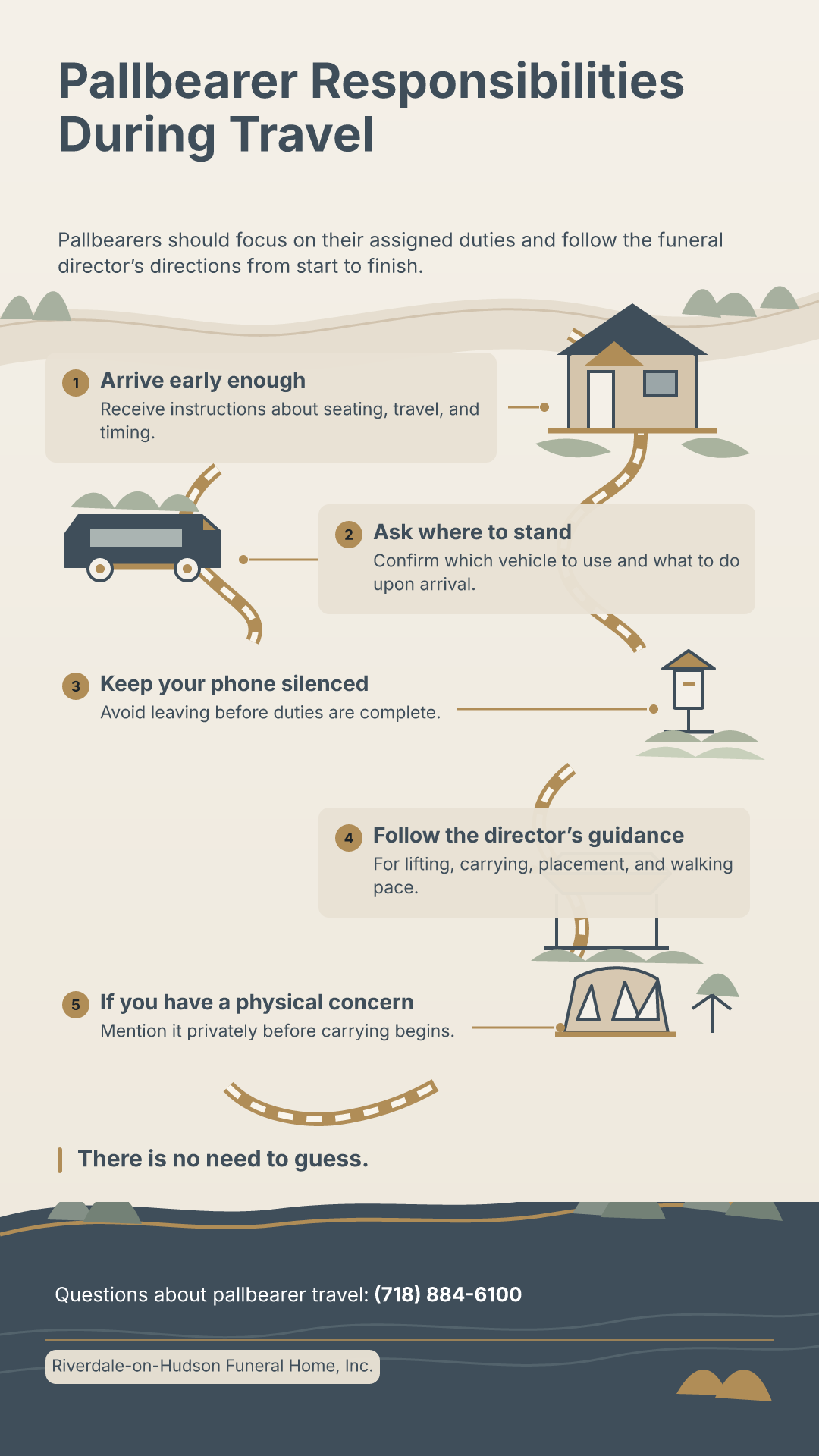
Pallbearers should focus on their assigned duties and follow the funeral director’s directions from start to finish. The role is meaningful, but it does not require memorizing a fixed set of rules.
These steps can help pallbearers arrive prepared and steady:
Arrive early enough to receive instructions about seating, travel, and timing.
Ask where to stand, which vehicle to use, and what to do upon arrival.
Keep your phone silenced and avoid leaving before duties are complete.
Follow the director’s guidance for lifting, carrying, placement, and walking pace.
If you have a physical concern, mention it privately before carrying begins.
Pallbearers may travel in a designated vehicle, with family members, or separately, depending on the service plan. There is no need to guess. Clear communication before departure is especially important if someone needs assistance entering or leaving the vehicle.
Guest Conduct at Each Arrival Point
Guests should arrive quietly, give the family room, and wait for directions before moving toward the service area. The goal is not to follow a perfect script. It is to avoid creating another decision for grieving relatives when they are trying to be present for the farewell.
At a cemetery, place of worship, chapel, or gathering space, people may be directed to enter in a particular order. Follow the funeral director or staff member’s lead. If no one is guiding the group, pause briefly and observe where close family members are being seated or gathered before choosing a place.
Where Should Guests Park and Wait?
Guests should park where directed and wait in a place that does not block arriving vehicles or the family’s path. If parking instructions have not been given, choose a suitable space and walk calmly toward the designated gathering area.
Do not assume the first people you see are ready to receive visitors. A family may need a few private minutes after arriving, particularly before a graveside farewell or final prayers. Waiting respectfully is often the kindest choice.
Family Space and Condolences
A brief condolence, a quiet embrace when appropriate, or a simple statement of support is usually enough. Long conversations can wait, especially when several people are trying to greet the family at once.
If you are unsure whether to approach, follow the family’s cues. Some relatives may welcome a few words immediately, while others may prefer to speak after the formal service. A guest’s presence can be meaningful without requiring a conversation.
Departure Etiquette
Leave according to the instructions given at the close of the service. In some settings, the family may depart first. In others, guests may be invited to offer condolences before leaving or to continue to another gathering.
Avoid lingering near vehicles if the family is preparing to leave. If you need to speak with someone about plans, choose a quiet moment away from the immediate departure area. Families considering travel between different service locations may also benefit from choosing a fitting service format, since the format often shapes the day’s schedule.
Instructions From a Funeral Home in Bronx
If you are still unsure where to go, whether to join the line of cars, or when to approach the family, ask before acting. The family contact, procession staff, or a funeral home in Bronx, NY can clarify the plan without making you feel as though you have interrupted.
Clear directions and patient driving matter more than rigid etiquette rules. Bronx funeral services may include different locations and travel arrangements, so the day’s instructions should always guide your choices. Riverdale-on-Hudson Funeral Home, Inc. is available if you need to talk with our team about service details. Call (718) 884-6100 to discuss the arrangements with care.